Modern lifestyles increasingly blur the boundary between day and night. The ubiquitous glow of screens—smartphones, tablets, computers, and televisions—extends artificial daylight deep into evening hours. This constant exposure to artificial light, particularly from digital devices, has fundamentally altered humanity’s relationship with natural circadian rhythms. Understanding how different wavelengths of light affect sleep architecture at the cellular level has become essential for maintaining optimal wellness in the digital age.
The Science of Light and Sleep
The human circadian system evolved over millennia to respond to natural light cycles. At the core of this system lies a sophisticated biological mechanism that uses specific light wavelengths as environmental cues to regulate sleep-wake patterns. Research has identified that not all light affects sleep equally—wavelength matters significantly.
The key player in this process is melatonin, often called the “sleep hormone.” This neurohormone, produced by the pineal gland, rises naturally in darkness to promote sleepiness and falls with light exposure to maintain wakefulness. However, modern research has revealed that certain wavelengths of light suppress melatonin production far more potently than others.
A study published in the Journal of Applied Physiology demonstrated that blue light wavelengths between 446 and 477 nanometers represent potent suppressors of melatonin in healthy humans [1]. The researchers found a dose-response relationship, with increasing intensities of blue light producing proportionally greater melatonin suppression. This discovery has implications for evening screen use, as digital devices emit peak emissions precisely within this blue wavelength range.
The mechanism behind this wavelength-specific sensitivity involves specialized cells in the retina called intrinsically photosensitive retinal ganglion cells (ipRGCs). These cells contain melanopsin, a light-sensitive protein that responds most strongly to blue light at approximately 479-480 nanometers [2]. When activated by blue light, these cells send signals directly to the brain’s master clock, the suprachiasmatic nucleus, which then suppresses melatonin production regardless of the time of day.
Red vs Blue Light Research: Comparative Effects on Sleep
Recent comparative studies have illuminated differences between how red and blue light affect sleep architecture. A 2025 study published in Life Journal directly compared evening exposure to blue light versus red light in healthy adults, measuring melatonin levels over time [3]. The findings showed that after one hour, both lights suppressed melatonin initially, but differences emerged after two hours. Blue light maintained suppression, while red light allowed some recovery. This pattern persisted throughout the third hour, confirming what researchers describe as red light’s circadian-friendly properties.
The practical implications extend beyond melatonin alone. A 2023 study examining sleep architecture found that individuals exposed to red light before bedtime experienced improvements in multiple sleep parameters compared to those exposed to white light [4]. The red light group showed:
- Shorter sleep onset latency (falling asleep faster)
- Increased total sleep time
- Improved sleep efficiency
- More complete REM sleep cycles
- Fewer microarousals during the night
Nature published research in 2022 demonstrating that blue-depleted evening environments (dominated by red-shifted wavelengths) produced measurable circadian phase advances and consolidated REM sleep compared to standard indoor lighting [5]. Participants residing in blue-depleted light environments for just five days showed advanced circadian rhythms and increased REM sleep duration—the sleep stage important for memory consolidation and emotional regulation.
Practical Light Management Strategies
Understanding the science enables evidence-based strategies for optimizing evening light exposure. Research indicates that two or more hours of screen time in the evening can disrupt the melatonin surge needed to fall asleep [6]. A large-scale JAMA study found that daily screen use before bed was associated with higher prevalence of poor sleep quality and approximately 7.64 fewer minutes of sleep on work nights [7].
Evidence-Based Evening Light Protocols:
Two Hours Before Bedtime:
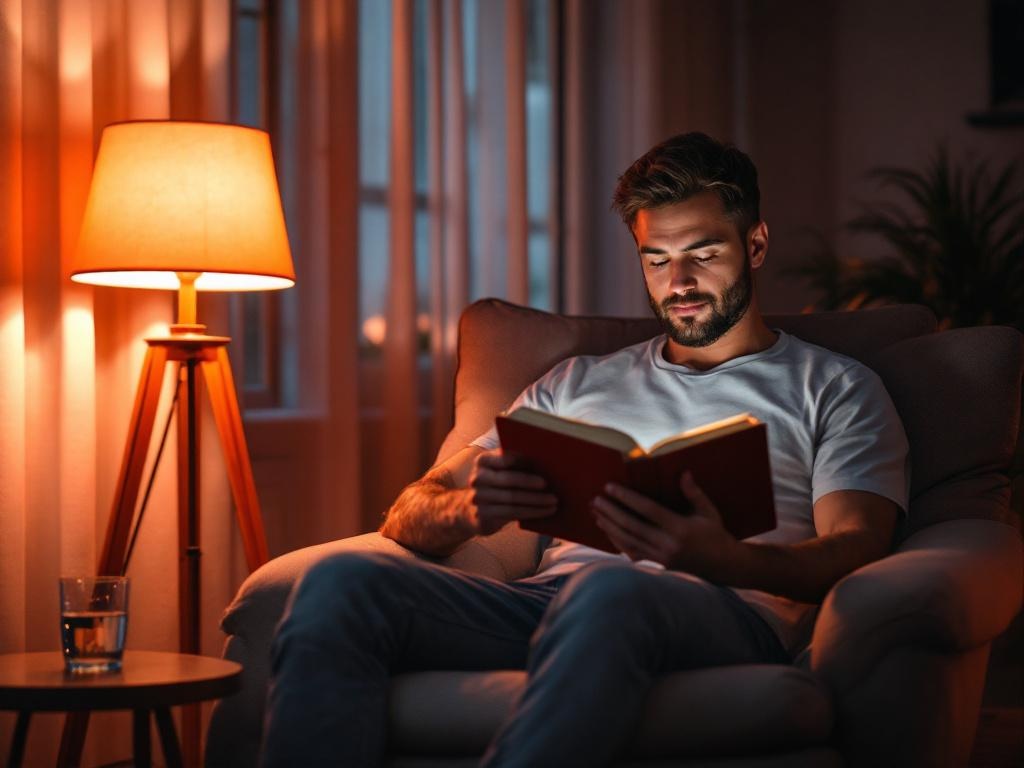
- Transition from bright overhead lighting to dimmer, warmer light sources
- Activate blue light filters on all digital devices
- Consider using amber-tinted glasses if screen use is necessary
One Hour Before Bedtime:
- Switch to red or amber lighting exclusively
- Minimize screen exposure entirely when possible
- Use e-readers with warm light settings rather than backlit tablets
Bedroom Environment:
- Install blackout curtains to eliminate external light pollution
- Use red nightlights if illumination is needed during the night
- Position alarm clocks to face away from the bed to minimize light exposure
Device Management:
- Enable automatic “night shift” or “blue light filter” modes on all devices
- Set devices to grayscale mode in the evening to reduce stimulation
- Charge phones outside the bedroom to eliminate temptation and light exposure
The Cellular Recovery Connection: Oxidative Stress and Sleep
While managing light exposure addresses the environmental factors affecting sleep, emerging research reveals important connections between sleep disruption and cellular-level oxidative stress. Studies have shown that reduced sleep across consecutive days induces measurable increases in certain biomarkers [8]. These biomarkers indicate heightened oxidative stress throughout the body.
The relationship between sleep and oxidative stress appears bidirectional. Research published in 2024 demonstrated that inadequate sleep may impact the body’s natural antioxidant defense systems, specifically through decreased NRF2 transcriptional activity [9]. This transcription factor normally activates genes that produce protective antioxidant enzymes. When sleep is disrupted, this protective mechanism becomes compromised, allowing reactive oxygen species to accumulate.
Furthermore, irregular or fragmented sleep patterns—similar to those caused by evening blue light exposure—have been associated with elevated oxidative stress biomarkers [10]. Individuals with disrupted sleep showed higher levels of malondialdehyde and basal oxidizability status, markers of cellular oxidative damage.
This is where molecular hydrogen enters the conversation as a complementary approach. Research has investigated molecular hydrogen’s selective antioxidant properties, particularly its ability to neutralize harmful reactive oxygen species while preserving beneficial signaling molecules. While light management addresses the external environmental factors disrupting sleep, molecular hydrogen represents a potential internal support system for managing oxidative stress associated with modern sleep challenges.
Studies have explored how molecular hydrogen may influence oxidative stress markers that become elevated during sleep deprivation. The science suggests that supporting the body’s antioxidant systems during periods of circadian disruption may help maintain cellular homeostasis while individuals work to optimize their sleep environment.
Building a Comprehensive Sleep Optimization Approach
Optimizing sleep quality in the modern world requires a multifaceted strategy that addresses both environmental and cellular factors. The research demonstrates that evening light exposure, particularly blue light from screens, disrupts natural sleep architecture through melatonin suppression. Red light emerges as a circadian-friendly alternative that allows the body to maintain more natural sleep-wake cycles.
The cellular consequences of disrupted sleep—increased oxidative stress and elevated markers—suggest that supporting the body’s internal recovery mechanisms may complement environmental light management strategies. While controlling light exposure tackles the primary circadian disruption, addressing the downstream cellular effects through evidence-based wellness approaches may provide additional support for those navigating the challenges of modern sleep disruption.
The path forward involves implementing practical light management protocols while remaining aware of the cellular-level processes affected by sleep quality. As research continues to unveil the complex relationships between light, sleep, and cellular health, individuals can make informed decisions about both their evening environment and their overall wellness strategies.
For those interested in exploring comprehensive approaches to sleep optimization and cellular wellness, understanding both the environmental and biological factors at play provides a foundation for making evidence-informed choices that support restorative sleep and daytime vitality.
Conclusion
The science is clear: evening blue light exposure from screens and artificial lighting suppresses melatonin and disrupts sleep architecture, while red light offers a more circadian-friendly alternative. Research demonstrates that implementing strategic light management protocols—transitioning to red-shifted lighting in the evening, minimizing screen exposure, and creating optimal bedroom environments—can measurably improve sleep quality and duration.
Beyond the immediate effects on sleep, the evidence reveals important connections between disrupted circadian rhythms and increased oxidative stress at the cellular level. This understanding opens doors to comprehensive wellness strategies that address both the environmental factors affecting sleep and the cellular recovery processes that occur during rest.
Explore our complete guide to natural sleep optimization strategies and discover how supporting cellular recovery can enhance your body’s nighttime restoration processes.
These statements have not been evaluated by the Food and Drug Administration (FDA). Holy Hydrogen products are not intended to diagnose or cure any disease. Holy Hydrogen does not make any medical claims or give any medical advice. All content is for educational and general wellness purposes only.
References
[1] Brainard GC, et al. “Dose-response relationship between light irradiance and the suppression of plasma melatonin in human volunteers.” Journal of Applied Physiology. 2011. https://journals.physiology.org/doi/full/10.1152/japplphysiol.01413.2009
[2] Hughes S, et al. “Signalling by melanopsin (OPN4) expressing photosensitive retinal ganglion cells.” Proceedings of the Royal Society B. 2012. https://royalsocietypublishing.org/doi/10.1098/rspb.2012.2987
[3] Malyshevskaya O, et al. “Effects of Evening Blue Light and Red Light on Melatonin Levels in Healthy Adults.” Life Journal. 2025. https://www.mdpi.com/2075-1729/15/5/715
[4] Zhang Y, et al. “Red light and sleep quality: A randomized controlled trial.” NIH PMC. 2023. https://pmc.ncbi.nlm.nih.gov/articles/PMC10484593/
[5] Spitschan M, et al. “Blue-depleted lighting and REM sleep consolidation.” Nature Scientific Reports. 2022. https://www.nature.com/articles/s41598-022-12408-w
[6] Sutter Health. “Screens and Your Sleep: The Impact of Nighttime Use.” https://www.sutterhealth.org/health/screens-and-your-sleep-the-impact-of-nighttime-use
[7] Rao R, et al. “Screen Use Before Bed and Sleep Outcomes in US Adults.” JAMA Network Open. 2023. https://jamanetwork.com/journals/jamanetworkopen/fullarticle/2831993
[8] Meier-Ewert HK, et al. “Effect of Sleep Loss on C-Reactive Protein.” Sleep. 2007. https://pmc.ncbi.nlm.nih.gov/articles/PMC1978405/
[9] Chen L, et al. “Sleep deprivation and antioxidant defense systems.” NIH PMC. 2024. https://pmc.ncbi.nlm.nih.gov/articles/PMC11199221/
[10] Watson S, et al. “Segmented sleep patterns and oxidative stress biomarkers.” Journal of Clinical Sleep Medicine. 2024. https://jcsm.aasm.org/doi/10.5664/jcsm.11036