The supplement aisle presents a confusing choice for athletes seeking optimal recovery: ubiquinone or ubiquinol? Marketing materials often proclaim one form superior to the other, yet research reveals a more nuanced reality. The distinction between these two forms of Coenzyme Q10 (CoQ10) matters less than the quality of the formulation itself—a critical insight that can save athletes money while maximizing cellular energy support.
The Molecular Foundation: Understanding CoQ10’s Dual Identity
Coenzyme Q10 exists in two primary forms that continuously interconvert within the body. Ubiquinone, the oxidized form, accepts electrons during cellular energy production. Ubiquinol, the reduced form, donates electrons and serves as a lipid-soluble antioxidant. This dynamic relationship makes both forms essential for mitochondrial function.
The electron transport chain relies on this oxidation-reduction cycle to generate ATP, the cellular energy currency. As ubiquinone accepts electrons, it transforms into ubiquinol. When ubiquinol donates electrons, it converts back to ubiquinone. This continuous interconversion occurs regardless of which form is consumed as a supplement.
Research demonstrates that CoQ10 appears in the blood mostly as ubiquinol, even when consumed as ubiquinone [10]. This finding challenges the marketing narrative that ubiquinol supplements provide superior benefits simply because they deliver the “active” form directly.
Bioavailability Deep Dive: Why Formulation Trumps Form
The absorption of CoQ10 presents unique challenges due to its large molecular size and fat-soluble nature. Both ubiquinone and ubiquinol face similar absorption barriers in the digestive system. However, the formulation technology used to overcome these barriers determines actual bioavailability more than the oxidation state.
Crystal formation represents the primary obstacle to CoQ10 absorption. Research indicates that proper CoQ10 crystal dispersion in the initial formulation is essential for optimal bioavailability [11]. When CoQ10 molecules aggregate into crystals, they become too large for intestinal absorption, regardless of whether they exist as ubiquinone or ubiquinol.
Advanced formulation technologies address this challenge through various approaches:
- Crystal-free solubilization maintains CoQ10 in a dissolved state
- Liposomal encapsulation protects molecules and enhances membrane penetration
- Emulsion formulations improve dispersion in intestinal fluids
- Carrier lipid selection optimizes absorption pathways
A comparative study revealed that well-formulated ubiquinone Coenzyme Q10 supplements can be absorbed effectively when compared to ubiquinol supplements [4]. This finding emphasizes that formulation quality supersedes the choice between oxidized and reduced forms.
Recent research on liposomal delivery demonstrates significant bioavailability improvements. Studies show enhanced absorption rates through improved solubility and protection in the gastrointestinal tract [9].
Athletic Performance Evidence: Dosage and Duration Matter
Research examining CoQ10 supplementation in athletes reveals consistent benefits for performance and recovery when proper protocols are followed. A systematic review found that supplementation at 200-300mg daily for 2-3 weeks may impact exercise capacity and recovery markers.
Studies in trained athletes demonstrate improvements in power output with consistent supplementation [1]. This improvement in power output may support both endurance and strength-based activities.
Recovery benefits appear equally interesting. Research shows that ubiquinol supplementation may support muscle performance after strenuous exercise in well-trained individuals [8]. Athletes may experience changes in various recovery markers.
The timing of tissue accumulation proves critical for athletic benefits. Studies indicate that plasma CoQ10 levels increase following 2 weeks of CoQ10 supplementation, with changes observed in muscle tissue as well [12]. This gradual tissue saturation explains why acute supplementation before competition shows limited effects compared to chronic daily intake.
Oxidative stress management represents another performance-related consideration. Research demonstrates that ubiquinol supplementation may influence certain oxidative markers [2]. This may help maintain cellular function during intense training periods.
Age-Related Considerations: When Form Selection Matters
The ability to convert ubiquinone to ubiquinol declines with age, making form selection more relevant for older athletes. Research in older men found differences in CoQ10 status between forms [3]. This age-related difference stems from declining enzymatic conversion capacity rather than absorption differences.
For athletes under 55, the body efficiently converts ubiquinone to ubiquinol after absorption. Studies show no significant difference in plasma CoQ10 levels between forms in younger populations when formulation quality is controlled. This finding suggests that younger athletes can achieve equivalent benefits from well-formulated ubiquinone supplements at potentially lower cost.
The conversion efficiency threshold appears around age 55-60, though individual variation exists. Factors influencing conversion capacity include:
- Overall mitochondrial health
- Oxidative stress levels
- Nutritional status
- Training intensity and recovery patterns
Athletes experiencing unusual fatigue or poor recovery despite adequate ubiquinone supplementation might benefit from trying ubiquinol, regardless of age. However, formulation quality should be evaluated first before switching forms.
Complementary H₂ Support: Dual Mechanisms for Mitochondrial Optimization
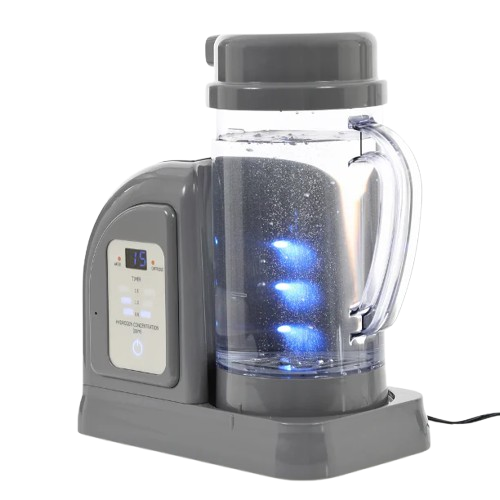
A separate field of research explores selective antioxidants that may support cellular energy production. Molecular hydrogen represents one such approach, offering properties distinct from CoQ10 supplementation, and can be conveniently delivered through hydrogen water.
Research indicates that H₂ molecules demonstrate selective properties regarding certain reactive species [5]. This selective action differs from CoQ10’s role in the electron transport chain.
The small size of hydrogen molecules enables unique cellular penetration. Studies note that H₂ can easily penetrate cellular membranes and rapidly diffuse into organelles [5]. This rapid diffusion creates different dynamics compared to CoQ10’s more gradual tissue accumulation.
Exercise studies examining molecular hydrogen supplementation found potential benefits for antioxidant capacity in healthy adults during certain types of exercise [6]. These observations represent a different mechanism from CoQ10’s electron transport function.
The timing differences between these approaches create strategic supplementation opportunities. CoQ10 requires weeks of daily intake for tissue saturation, while molecular hydrogen can be used acutely before training sessions. This combination allows athletes to address different aspects of cellular support.
Practical Implementation: Evidence-Based Protocols
Successful CoQ10 supplementation requires attention to dosage, timing, and formulation selection. Research-supported protocols suggest the following approach:
Dosage Guidelines:
- Standard athletic support: 200-300mg daily
- Loading phase: Consider 300mg daily for first 2-3 weeks
- Maintenance: 200mg daily after tissue saturation
Timing Strategies:
Studies demonstrate that food intake enhances the intestinal absorption of CoQ10 [7]. Taking supplements with meals containing fat significantly improves absorption. Morning intake with breakfast allows for consistent daily dosing while optimizing absorption conditions.
Formulation Selection Criteria:
- Look for crystal-free or solubilized preparations
- Consider liposomal or emulsion formulations for enhanced bioavailability
- Verify third-party testing for purity and potency
- Compare cost per absorbed mg rather than label dose
Combined Protocol Suggestions:
For athletes interested in complementary approaches, consider:
- Daily CoQ10 supplementation for baseline mitochondrial support
- Pre-training molecular hydrogen for additional support
- Post-workout timing for both during heavy training blocks
Assessment Timeline:
Allow 3-4 weeks of consistent supplementation before evaluating effects on performance and recovery. Monitor subjective energy levels, recovery time between sessions, and performance metrics specific to training goals.
Conclusion: Quality Over Marketing Claims
The ubiquinone versus ubiquinol debate obscures the more important factor determining CoQ10 effectiveness: formulation quality. Research consistently demonstrates that crystal-free, properly solubilized preparations achieve superior absorption regardless of oxidation state. For athletes under 55, well-formulated ubiquinone provides equivalent benefits to ubiquinol at potentially lower cost.
The evidence supports a practical approach focused on consistent daily supplementation at 200-300mg, taken with meals containing fat, using formulations that prevent crystal formation. Athletes seeking comprehensive mitochondrial support might consider combining CoQ10’s direct participation in energy production with molecular hydrogen’s selective properties.
Understanding these nuances empowers athletes to make informed supplementation choices based on scientific evidence rather than marketing claims. Explore evidence-based strategies for optimizing cellular energy and recovery through complementary wellness technologies, including autophagy: understanding natural cellular renewal processes that prioritize formulation engineering over simplified form comparisons.
Medical Disclaimer
These statements have not been evaluated by the Food and Drug Administration (FDA). The information presented is for educational and general wellness purposes only and should not be considered medical advice. Holy Hydrogen products are not intended to diagnose, treat, cure, or prevent any disease. Consult with a qualified healthcare professional before making changes to your supplement regimen, especially if you have existing health conditions or take medications.
References
[1] Alf D, et al. “Ubiquinol supplementation enhances peak power production in trained athletes: a double-blind, placebo controlled study.” Journal of the International Society of Sports Nutrition. https://pmc.ncbi.nlm.nih.gov/articles/PMC3661336/
[2] Díaz-Castro J, et al. “Coenzyme Q₁₀ supplementation ameliorates inflammatory signaling and oxidative stress associated with strenuous exercise.” Redox Report. https://pmc.ncbi.nlm.nih.gov/articles/PMC6748686/
[3] Zhang Y, et al. “Ubiquinol is superior to ubiquinone to enhance Coenzyme Q10 status in older men.” Food & Function. https://pubmed.ncbi.nlm.nih.gov/30302465/
[4] Morrill R. “Coenzyme Q10 Comparison Study of Ubiquinone and Ubiquinol Absorption.” Q10Facts. https://www.q10facts.com/coenzyme-q10-comparison-study-of-ubiquinone-and-ubiquinol-absorption/
[5] Ohta S. “Molecular hydrogen as a preventive and therapeutic medical gas: initiation, development and potential of hydrogen medicine.” Oxidative Medicine and Cellular Longevity. https://pmc.ncbi.nlm.nih.gov/articles/PMC6988658/
[6] Hong Y, et al. “Effects of molecular hydrogen supplementation on fatigue and aerobic capacity in healthy adults: A systematic review and meta-analysis.” Frontiers in Nutrition. https://pmc.ncbi.nlm.nih.gov/articles/PMC10999621/
[7] Ochiai A, et al. “Improvement in intestinal coenzyme q10 absorption by food intake.” Yakugaku Zasshi. https://pubmed.ncbi.nlm.nih.gov/17666877/
[8] Fernández-Lázaro D, et al. “The Effects of 6 Weeks of Ubiquinol Supplementation on Muscle Damage and Performance after Strenuous Exercise in Well-Trained Athletes: A Randomized Controlled Trial.” https://pmc.ncbi.nlm.nih.gov/articles/PMC10295177/
[9] Liu K, et al. “Single-dose pharmacokinetics and comparative bioavailability of liposomal and standard formulations of CoQ10 in healthy adults: a randomized, double-blind, crossover study.” Frontiers in Nutrition. https://www.frontiersin.org/journals/nutrition/articles/10.3389/fnut.2025.1605033/full
[10] López-Lluch G, et al. “Bioavailability of coenzyme Q10 supplements depends on carrier lipids and solubilization.” https://pmc.ncbi.nlm.nih.gov/articles/PMC7146408/
[11] Mantle D, Dybring A. “Bioavailability of Coenzyme Q10: An Overview of the Absorption Process and Subsequent Metabolism.” https://pmc.ncbi.nlm.nih.gov/articles/PMC7278738/
[12] Cooke M, et al. “Effects of acute and 14-day coenzyme Q10 supplementation on exercise performance in both trained and untrained individuals.” https://pmc.ncbi.nlm.nih.gov/articles/PMC2315638/